



See the operating map
Keep solutions, templates, grids, marketplace capability, providers, and billing connected to the subscription they belong to.
EngineGrids turns raw agentic capability into governed business assets. We replace brittle integration glue with a Native PostgreSQL interface that lets developers, users, and agents manage the entire environment through the world's most trusted data standard.
Day 2 operators
Once a workflow is live, operators need a calm place to see what is running, what it costs, what is linked, and what needs attention. EngineGrids brings solutions, runtime grids, marketplace entitlements, billing, capacity, provider connections, and operating priorities into one workspace built for day-two responsibility.
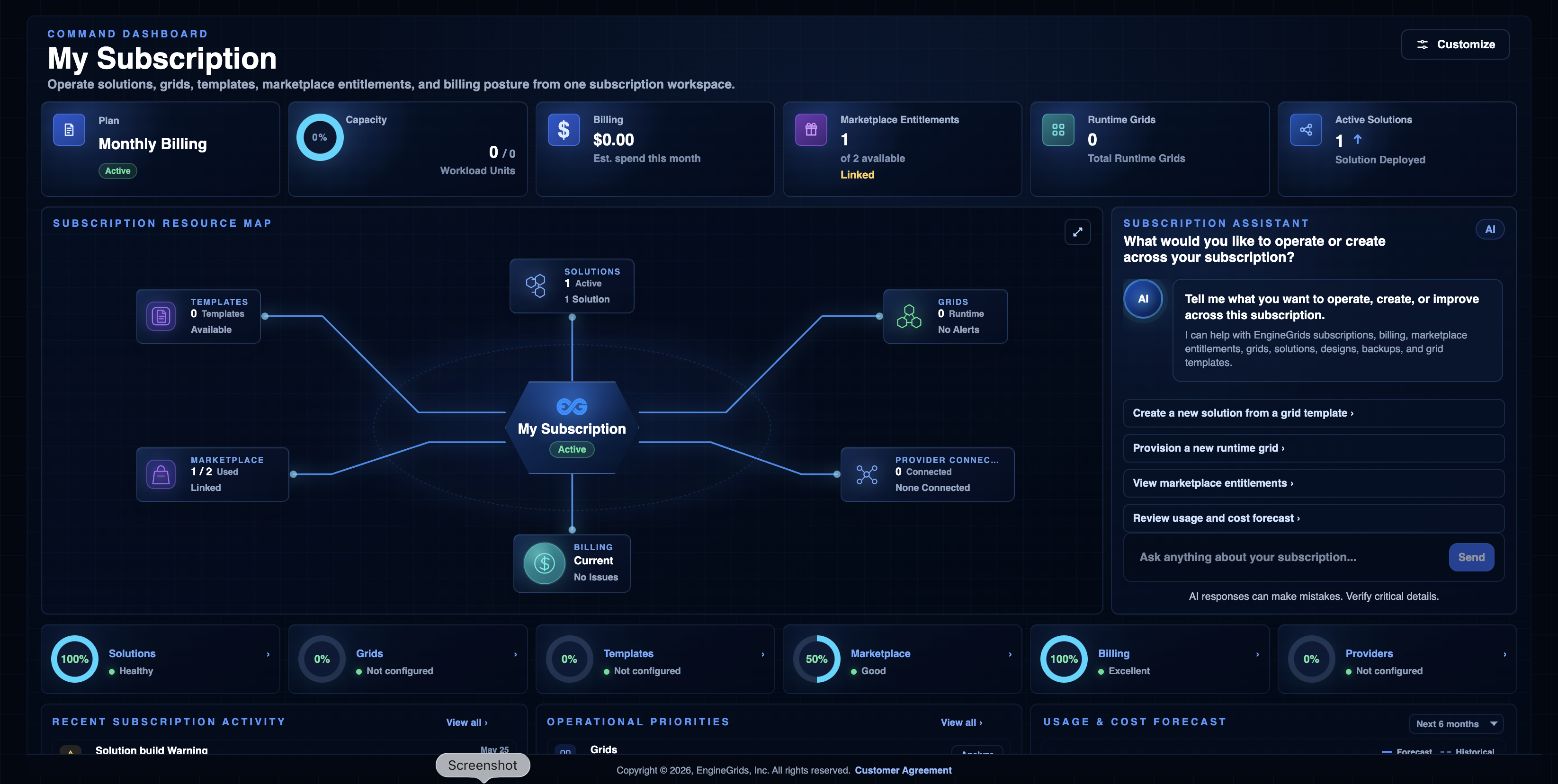
Keep solutions, templates, grids, marketplace capability, providers, and billing connected to the subscription they belong to.
Track capacity, active solutions, billing state, usage forecast, and operational priorities without switching tools.
Use the subscription assistant and clear next actions to create, provision, review, and expand only when the workspace is ready.
EngineGrids keeps install order, service bindings, and runtime state on one Native PostgreSQL control plane. This is how real environments grow into durable company property instead of collapsing into brittle integration glue.
Governed state
EngineGrids replaces scattered provider SDKs with app surfaces your team can inspect. When a grid needs Stripe or Salesforce, it acts through tables where intent and outcome stay visible.
Key Takeaways
Durable runtime
Grid management is not a separate infrastructure task. Scaling, backup, and service control all follow the same operating model, whether initiated by a developer, user, or agent.
Key Takeaways
Marketplace scale
External agents and swarms from the marketplace attach as platform subscriptions. You grant entitlements and supervise work through the same rows used for internal services.
Key Takeaways
Capability, provider actions, and environment state live on one operating path instead of being scattered across custom middleware.
Developers and agents use the same auditable interface to scale, protect, and extend the grid as the business needs grow.
Important actions are recorded in platform state so AI operations stay explainable after the pilot ends.
Policies and service controls stop unsafe actions before they reach customers, records, or internal business systems.
EngineGrids turns these systems into governed data operations. We install the app surfaces and bindings a grid needs, then let agents and operators work through auditable tables instead of brittle provider code.
EngineGrids catches non-deterministic agent intent and commits it to deterministic PostgreSQL transactions. This is how real-world AI becomes auditable, reversible, and production-credible.
Select a scenario and run it to see the agent's raw intent.
EngineGrids catches non-deterministic thought and commits it to state.
The same governed SQL interface can install capability, move money, subscribe to marketplace agents and swarms, resize the environment, and protect it with recoverable backup state, whether the change is initiated by a developer, a business user, or the agents doing the work themselves.
Desired state
Installing governed capability starts from platform state, not a connector project. The grid asks for the service it needs, and EngineGrids resolves the subscription, app surface, and bindings in dependency order.
Why it matters
Capability install is already part of the operating platform. Developers, users, and agents can all use the same inspectable interface without rebuilding the integration layer every time the grid grows.
1. Request the service
A single row in `grid.services` asks the platform to install governed Stripe capability for the grid.
insert into grid.services (name)
values ('stripe');
2. Inspect the resolved service
The resolved plan, subscription, billing state, and operational status remain inspectable without leaving the platform.
select
    service_name,
    status,
    resolved_plan_version,
    subscription_id,
    billing_state
from infrastructure.service_status_view
where service_name = 'stripe';
The difference is whether your team can keep expanding AI responsibility after launch without retreating into manual supervision and hidden glue.
Most platforms treat agents as isolated experiments. They connect to APIs and chain tools, but the execution, approvals, and audits splinter once the work becomes real.
We turn integrations into visible data operations. Important side effects are recorded, state changes can be reviewed, and agents stay inside platform boundaries.
Because your AI systems run on one operating layer, you can move from a single agent to a broader business workflow without losing visibility.
When installation, runtime, and side effects stay on one operating path, your team can let AI systems take on real work without retreating into custom glue or manual fallback.